2019 UnConference
Disability Studies and Action Collaborative
October 19, 2019
–
Carver Academic Building
Western Washington University
Welcome
Thank you for joining us for the first iteration of the Disability Studies and Action Collaborative (DSAC) UnConference. We hope today’s activities will allow us to learn from one another and find exciting new ways to collaborate in the future.
As you read through this program, keep in mind that this UnConference is designed to be collaborative, flexible, and exploratory. If you find yourself feeling penned in by the structure or wishing for something that we haven’t planned for, please speak up. We want to adapt this day to suit the interests, needs, and greatest ambitions of the participants. You are the event. It should reflect all of our concerns.
This program in broken into the following sections:
Navigate this page
Structure of the UnConference
This UnConference is designed to be a kind of free-form workshop where people can come together from many different walks of life to collaborate about issues of disability, access, and community building. While typical conferences tend to focus on lecturing, this UnConference focuses on direct, hands-on problem solving. Our goal is to learn about one another’s work and concerns, and then to find ways that we can work together to create something new.
The most important work you do at the UnConference will be in your working group. These are groups of around 10 people that we have initially grouped together based on what you told us in your UnConference application. You’ll read more about how working groups function in the “About Working Groups” section below.
Your working group will be your home base for the UnConference. You will work together to identify an important problem or project idea that is relevant to your group members. You will then collaborate to create some kind of tangible outcome emerging from your conversation to present by the end of the UnConference. You will do this together during the three breakout sessions (one session before lunch and two sessions after lunch).
In addition to your time in your working group, you will also have the opportunity to attend a seminar session. These are pre-prepared talks that will be presented by your fellow UnConference participants. The presentation schedule runs throughout the day. You will find the full schedule in the “About the Seminar Sessions” section below. Schedules will also be posted throughout the rooms. If you would like to follow real-time chatter of the conference volunteers and organizers or post a call for assistance to the help-line, a DSAC Discord channel has been created for this purpose (see the Meet The Participants page open to UnConference participants).
We ask that you spend most of your time with your working group, while ducking out occasionally to hear a presentation.
There will also be plenary sessions throughout the UnConference. These will include meals, featured speakers, and the final session of the day, in which we will discuss what the working groups accomplished for the day.
Schedule of the Day
- 9:30-10:00 – Room CV 207 – Breakfast and coffee reception and registration
- 10:00-10:15 – Room CV 207 – Welcome from Andrew Lucchesi (UnConference Coordinator)
- 10:15-10:30 – BREAK
- 10:30-11:45 – First Breakout Session
- Working Groups in assigned rooms
- Presentations in Seminar Room A: CV 103
- Presentations in Seminar Room B: CV 104
- 11:45-12:00 – BREAK
- 12:00-12:45 – CV 207 – Catered lunch
- 12:45-1:00 – BREAK
- 1:00-1:45 – CV 207 Plenary session with Cori Knight, University of California Riverside
- 1:45-2:00 – BREAK
- 2:00-3:15 – Second Breakout Session
- Working Groups in assigned rooms
- Presentations in Seminar Room A: CV 103
- Presentations in Seminar Room B: CV 104
- 3:15-3:30 – BREAK
- 3:30-4:15 – Third Breakout Session
- Working Groups in assigned rooms
- Presentations in Seminar Room A: CV 103
- Presentations in Seminar Room B: CV 104
- 4:15-5:00 – Plenary session with Working Group reports
- 5:30-8 – Ruckus Room Arcade and Railroad St Restaurants
About the Working Groups
You will meet with your working group during each of the three breakout sessions, which happen once before lunch and twice after lunch. A facilitator will help guide your working group through a series of brainstorming and idea-development activities to help everyone explore what disability-related issues, problems, or ideas are important to everyone in the group.
For instance, one group might find that its members are most concerned about issues related to public learning institutions like libraries, museums, and cultural centers. That group might spend their time planning and creating a guide to train curators or program developers about resources for creating accessible, disability-affirming activities or events. People in that group may come from different walks of life and professional backgrounds, and therefore they may have very different skillsets to offer to this project. But by working together on a shared goal, we will have the opportunity to learn about each other’s skills, concerns, and ambitions, which will–we hope–serve as the basis for future collaborations once the UnConference is over.
One thing to note is that you have been assigned to initial working groups based on what you wrote in your application materials. You are not required to stay with this group during the full day. At lunch, you will have the opportunity to swap working groups–for instance if another group is working on a project that catches your attention.
Working Group Room Assignments
See our Meet the Participants page for the full list of working group assignments. You will also find full bios for all group members.
- Group 1 Facilitated by Cathy McDonald and Jo Hurt
- Room CV 207 East
- Group 2 – Facilitated by Katie Weed
- Room CV 207 West
- Group 3 – Facilitated by Dimitri Dounas-Frazer
- Room CV 264
- Group 4 – Facilitated by GIM and Erin Howard
- Room CV 265
- Group 5 – Facilitated by Allison Giffen
- Room CV 272
About the Seminar Sessions
During the three breakout sessions (one before lunch and two after lunch), we will have two rooms set aside for UnConference participants to give presentations on topics they’ve prepared in advance. You can access downloadable materials from these presentations on the Meet the Participants page, and we will also have large-print copies available during each presentation.
The presentations vary in lengths and formats, ranging from 5-minute presentations on isolated topics, to panels of short presentation on a shared topic, to 20-25 minute stand-alone presentations. One of the UnConference facilitators will be at each session to help keep time and manage logistics.
We hope these Seminar Sessions will provide a fascinating supplement to the work you do with your working group. Look through the schedule of presentations as well as the full descriptions of each presentation on the Meet the Participants page. Plan to spend the majority of your time with your working groups, but also select presentations that seem interesting to you. Remember that downloadable materials will be available to you even after the UnConference, so if you miss a presentation, you can always follow up with the presenter at a later time (or during lunch!).
Schedule of Seminar Session Presentations
Full presentation descriptions and downloadable materials are available to UnConference participants at the Meet the Participants page
First Breakout Session – 10:30-11:45
- *Working Groups in Assigned Rooms*
- Seminar Sessions on a Drop-In Basis
- Seminar Room A: Carver 103
- 11:00 – Michael Richardson: “Overview of the ADA”
- 11:20 – Kristina Marie Sawyckyj: “ADA access into Shelters and transitional housing including dorms, temporarily used to house homeless students”
- 11:35 – John M. Denooyer: “Retaining employment”
- Seminar Room B: Carver 104
- 11:00 – Gracen Brilmyer: “Re/telling History: How disabled people understand themselves through archives”
- 11:30 – JoAnne Woiak: “Interdependence and collective access as disability studies pedagogy”
- Seminar Room A: Carver 103
Plenary Presentation: Carver 207 (Following Lunch)
- 1:00 – Corriene Knight: “Proposing a comprehensive shift in meeting the needs of students with chronic illness on campus”
Second Breakout Session – 2:00-3:15
- *Working Groups in Assigned Rooms*
- Seminar Sessions on a Drop-In Basis
- Seminar Room A: Carver 103
- 2:00 – Kestrel Hae Kyung Corona: “Disability Representation in Modern Media”
- 2:30 – Kristen Chmielewski: “The important consideration, after all, is disability”: City teachers and disability,1930 – 1970”
- 2:50 – Meghan Fitzgerald: “Mental health is a filter that can rearrange our education”
- Seminar Room B: Carver 104
- 2:00 – Mike Gorday: “The Basics of Bias Development”
- 2:30 – Englantina Casares “Barriers Encountered for People With Disabilities”
- 2:50 – Deborah Hanuscin: “Universal design for teaching? Reducing barriers for faculty with disabilities”
- Seminar Room A: Carver 103
Third Breakout Session – 3:30-4:15
- *Working Groups in Assigned Rooms*
- Seminar Sessions on a Drop-In Basis
- Seminar Room A: Carver 103
- Panel: “Encounters with Disability in 19th Century culture and literature”
- 3:30 – Kathleen Brian
- 3:45 – Laura Laffrado
- 4:00 – Allison Giffen
- Panel: “Encounters with Disability in 19th Century culture and literature”
- Seminar Room B: Carver 104
- Panel “Autism, neurodiversity and college”
- 3:30 – Dr. Fletcher Scott
- 3:45 – Alex Edgeworth
- 4:00 – Lisa Osadchuk
- Panel “Autism, neurodiversity and college”
- Seminar Room A: Carver 103
Maps and Other Resources
You can find a full listing of helpful materials on the Local Resources and Guides page.
The first floor of Carver is where you will find the registration table and CV 103 and 104. These are the rooms where all of the Seminar Session presentations will be held. The first floor has both single-sex restrooms and one gender-neutral single-occupant restroom.
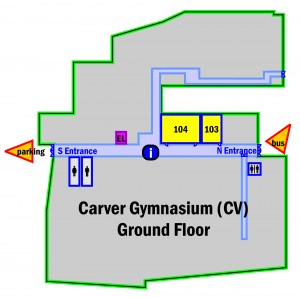
Carver Gymnasium (CV) Ground Floor
Most of the UnConference will take place on the second floor. The opening reception and lunch will take place in Carver 207. The plenary speaker and plenary concluding session will also be in Carver 207.
The second floor has a large flex area with tables, benches, and chairs, which you are free to use individually or with your working group. Carver 261 is reserved as a quiet room for participants to use if they need to.
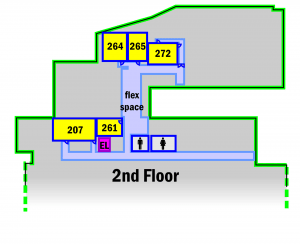
Carver Gymnasium (CV) Second Floor
In addition to these facilities in Carver, we also have access to the nearby Humanities building, which has two computer labs you might use, either as an individual or as part of a working group. This building will be locked when we aren’t using it, so please ask one of the facilitators or volunteers if you would like to use it.
Supported by
-
- Melynda Huskey, Vice President for Enrollment and Student Services
- The Disability Access Center
- Department of English
- Department of Science, Mathematics, Technology, and Education (SMATE)
- Generous donations through the DSAC UnConference Viking Funder campaign