
NonFiction Book-
- You Can Save The Planet: 50 Ways You Can Make a Difference by Jacquie Wines, publisher is Scholastic Reference (2008).
- This book is full of ways middle school students and people in general can be more environmentally friendly and help take care of the Earth. This book introduces the greenhouse effect and global warming which would go along with a science lesson that overlaps with the unit on environmental health. When studying environmental health and science, I would have the students pick 2-3 different topics from the book each. They will become an “expert” on those topics and will share what they learned about those topics in groups or with the whole class. (Each student will get a copies of their section of the book.)
- One of the many “how to” steps is, “Ways to organize your household recycling that really work.”
- National Health Education Standards (NHES), Healthy Behavior Outcomes, and Learning Objectives:
- H1.W2.6 Differentiate between communicable and noncommunicable diseases.
- PHW1.8.5 Summarize actions to protect oneself against potential damage from exposure to the sun.
o HBO 5. Prevent damage from the sun.
- PHW1.8.9 Summarize health practices to prevent the spread of infectious diseases that are transmitted by food, air, indirect contact, and person-to-person contact.
o HBO 6. Practice behaviors that prevent infectious diseases.
- PHW1.8.12 Explain the behavioral and environmental factors that contribute to the major chronic diseases.
o HBO 7. Practice behavior that prevent chronic diseases.
NHES 4: Students will demonstrate the ability to use interpersonal communication skills to enhance health and avoid or reduce health risks.
- H4.W5.6 Explain effective communication skills.
- H4.W5.7 Use communication skills effectively with family, peers, and others.
- H4.W5.8 Demonstrate communication skills to enhance health and avoid or reduce health risks.
NHES 7: Students will demonstrate the ability to practice health-enhancing behaviors and avoid or reduce health risks.
- H7.W2.8a Analyze how personal choices contribute to communicable and noncommunicable diseases.
- H7.W2.8b Assess personal health behaviors that reduce or prevent health risks.
- Core Integration:
- I would integrate this into a science lesson/unit. The science lesson would have to do with the environment and how human impact it. Then environmental health comes into the topic.
- “How can we make connections between what we are learning about in science and this text?”
- A: Natural Resources
Humans depend on Earth’s land, ocean, atmosphere, and biosphere for many different resources. Minerals, fresh water, and biosphere resources are limited, and many are not renewable or replaceable over human lifetimes. These resources are distributed unevenly around the planet as a result of past geologic processes. - 6-8.1: Cite specific textual evidence to support analysis of science and technical texts. (MS-ESS3-1)
- 6-8.2: Write informative/explanatory texts to examine a topic and convey ideas, concepts, and information through the selection, organization, and analysis of relevant content. (MS-ESS3-1)
- 6-8.9: Draw evidence from informational texts to support analysis, reflection, and research. (MS-ESS3-1)
Fiction Book-
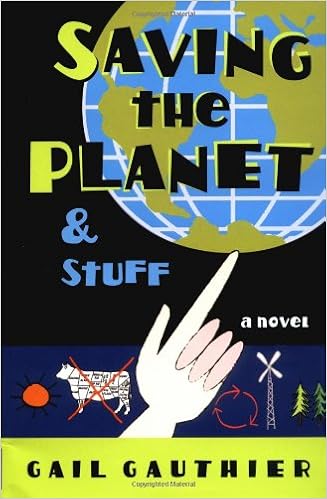
- Saving The Planet & Stuff by Gail Gauthier, G.P. Putnam’s Sons Books for Young Readers (June 2, 2003)
- This is a fictional book about a boy who is interning at his grandparent’s environmental magazine. He learns a lot from his environmentally-friendly grandparents and I think my middle schoolers could too with this book. I would have the students read this book during language arts I would also have the students have scientific discussions about the story when they have all completed it. This is a light-hearted, yet informational book the students would enjoy and could relate to because the main character is a teenager and may have a very similar attitude to them.
(pages from chapter 15 of the ebook)
- National Health Education Standards (NHES), Healthy Behavior Outcomes, and Learning Objectives:
PHW1.8.9 Summarize health practices to prevent the spread of infectious diseases that are transmitted by food, air, indirect contact, and person-to-person contact.
· PHW1.8.12 Explain the behavioral and environmental factors that contribute to the major chronic diseases.
NHES 4: Students will demonstrate the ability to use interpersonal communication skills to enhance health and avoid or reduce health risks.
· H4.W5.6 Explain effective communication skills.
· H4.W5.7 Use communication skills effectively with family, peers, and others.
· H4.W5.8 Demonstrate communication skills to enhance health and avoid or reduce health risks.
NHES 7: Students will demonstrate the ability to practice health-enhancing behaviors and avoid or reduce health risks.
· H7.W2.8a Analyze how personal choices contribute to communicable and noncommunicable diseases.
· H7.W2.8b Assess personal health behaviors that reduce or prevent health risks. - Core Integration:
- I would have the students read this book during language arts I would also have the students have scientific discussions about the story when they have all completed it. Perhaps they could write about it and make connections to science concepts they are learning.
- “How can we make connections between what we are learning about in science and this text?”
- A: Natural Resources
Humans depend on Earth’s land, ocean, atmosphere, and biosphere for many different resources. Minerals, fresh water, and biosphere resources are limited, and many are not renewable or replaceable over human lifetimes. These resources are distributed unevenly around the planet as a result of past geologic processes. - 6-8.1: Cite specific textual evidence to support analysis of science and technical texts. (MS-ESS3-1)
- 6-8.2: Write informative/explanatory texts to examine a topic and convey ideas, concepts, and information through the selection, organization, and analysis of relevant content. (MS-ESS3-1)
- 6-8.9: Draw evidence from informational texts to support analysis, reflection, and research. (MS-ESS3-1)