In 1996, the original Tomb Raider released to critical acclaim and commercial success. Before then, games had been successful, so why is the success of Tomb Raider different? The answer is surprisingly simple. It featured one of the first female protagonists present in video games. More importantly, said protagonist, Lara Croft, would go on to become one of the most iconic characters in gaming, spawning two movie adaptations as well as a prequel/ reboot trilogy in 2013.
While this seems like good news for the progression of modern representation of women in video games, we must ask the question, what made Lara so popular to begin with. Coined the original cyberbabe, critics, well, criticize 1996 Lara’s physical appearance, claiming her unrealistic proportions and revealing clothing is impractical and sexist. Why are her breasts the half the size of her entire body? Does it enhance gameplay perhaps? Or maybe her short shorts are necessary, to, um, prevent heat exhaustion?
More likely, Lara’s scantily clad adventures are simply a marketing ploy. Made by men, to a perceived mostly male audience, Lara’s initial appearance is a testament to how women are viewed in video games. And although there are certainly more offensive examples, Lara is most relevant because of how far she has come as a character, in all her different incarnations.
In the 2013 reboot, Lara Croft is almost unrecognizable from her first appearance in 1996, and not just because of increased pixels. She is dressed adequately, and she has a proper physique for her athletic lifestyle. She is still conventionally attractive, but what video game protagonist isn’t? However, many complained of her unoriginal backstory, weaker character, and even a controversial rape scene that was as quickly cut (or modified) as it was announced. So, now we have a more realistic looking character, but we have 1) sacrificed the edge of the original and 2) set a precedent for decent looking but weakly written female characters.
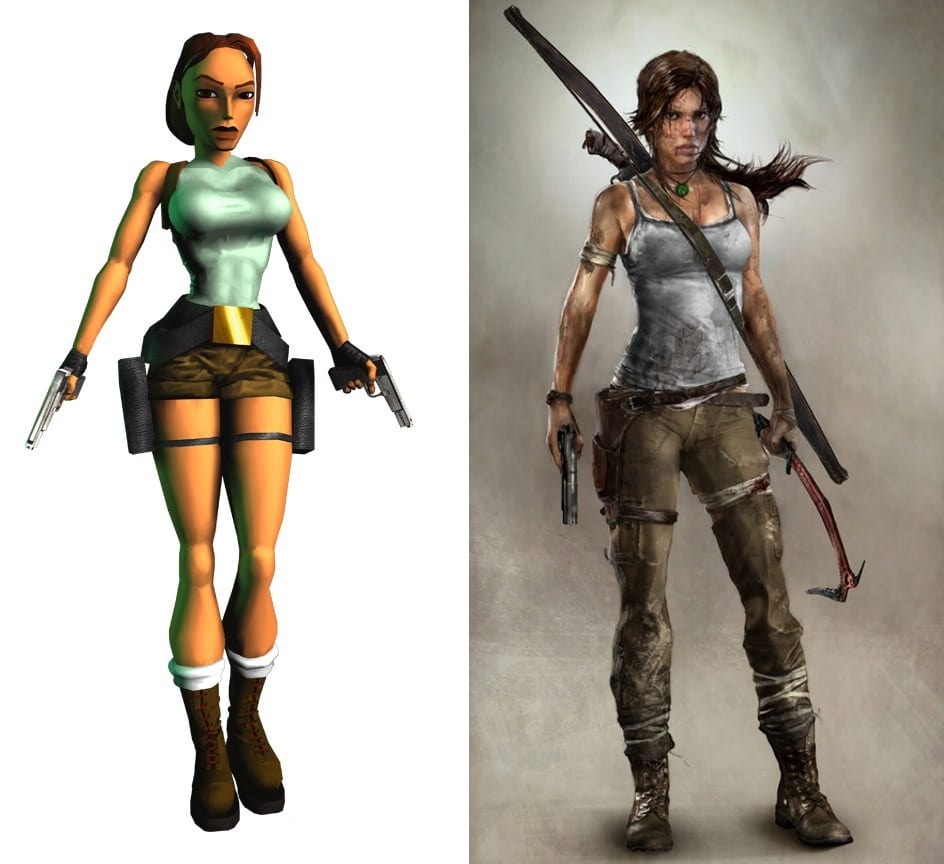
A comparison between two different generations of Lara Croft.
So what is the message here? Well, games and the gaming industry have come a long way since 1996. Graphics, writing, gameplay mechanics have all become more complex and immersive then ever before, and advances are made every year. However, the representation of women is a common and controversial issue, all these years later still. Lara Croft’s tradeoff, going from a cool headed but sexualized protagonist, to a weaker but more acceptable and practical looking woman is a perfect example of the problem with representation of women in games. Is this sexualization necessary to sell games? How much more disrespectful, or even sub-par representation are gamers willing to deal with? And how does this harmful representation reflect society, or even influence it? These are all questions we aim to tackle.
Before we go on, we should not discount the marvel that is the original game. It was successful on a technical level and a legitimately fun and enticing game, especially for its time. Read more about it here.
Hi, this is a comment.
To get started with moderating, editing, and deleting comments, please visit the Comments screen in the dashboard.
Commenter avatars come from Gravatar.